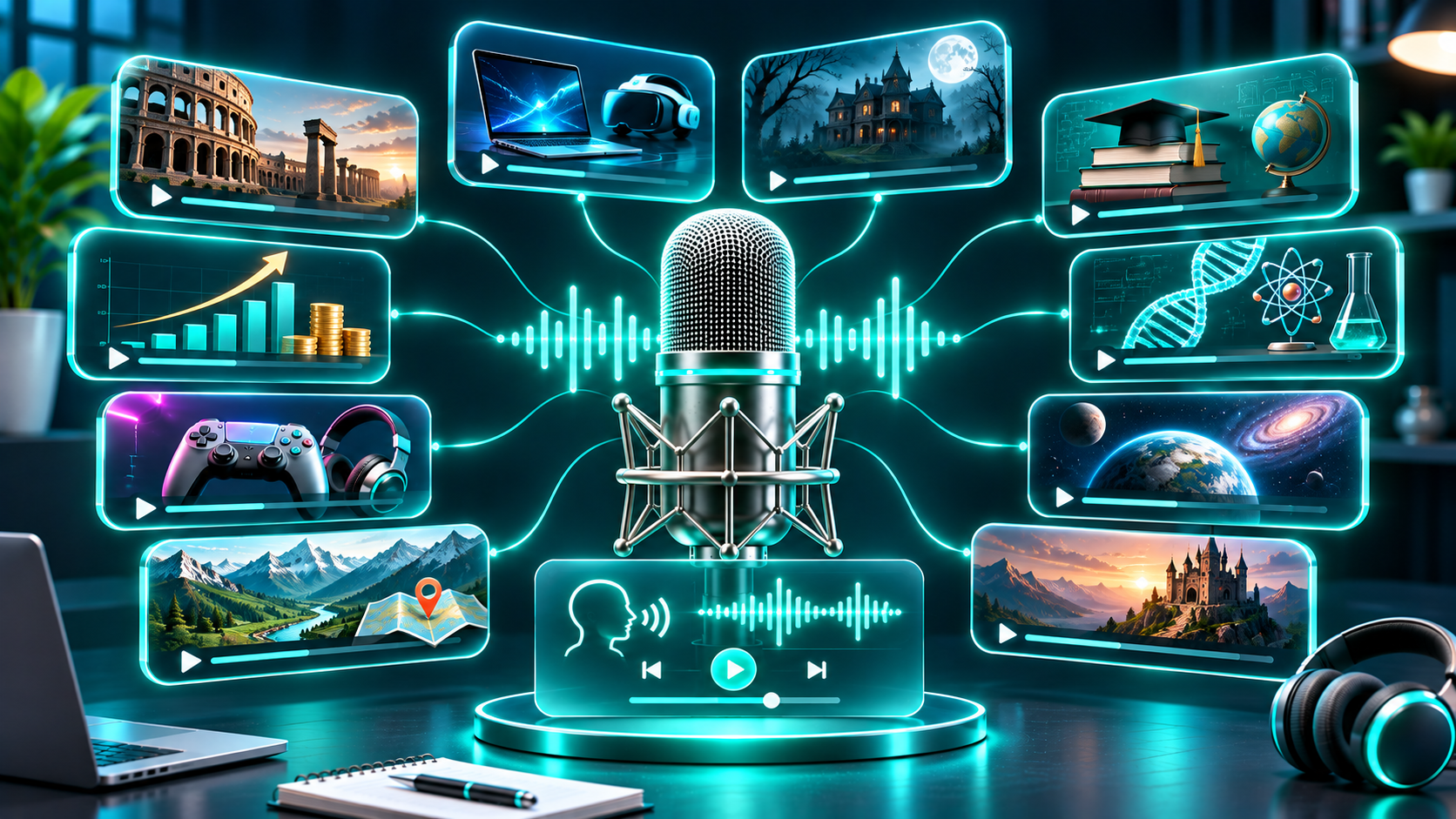
A faceless channel can put the subject, visuals, and storytelling ahead of the presenter. Narration—recorded or generated—can connect diagrams, archival materials, demonstrations, or scenes into one clear video. The format is flexible, but a voiceover alone does not make a video distinctive. YouTube says monetized channels should be original and authentic, and that repetitive or mass-produced content can be ineligible; reviewers may assess a channel as a whole, not just one upload.
So treat the following as creative starting points, not guaranteed trends, profitable niches, or forecasts. Pick a subject you can research carefully and bring a point of view to. For every format, the audience, episode idea, original-value angle, and caution are spelled out.
1. Everyday science explainers
Audience: Curious viewers seeking clear explanations of everyday phenomena. Sample video: “Why does a metal spoon feel colder than wood?” Original-value angle: Pair a simple demonstration with a labeled diagram and plain-language explanation. NASA’s learning resources offer educational materials and activities for science-topic research. Production caution: Verify claims and label illustrative animation so it is not mistaken for real footage.
2. History through primary sources
Audience: Students and general viewers curious about historical evidence. Sample video: “What can an 1800s campaign poster tell us about an election?” Original-value angle: Interpret a document in context and compare it with another source, rather than reciting a timeline. The Library of Congress offers classroom sets of speeches, maps, newspapers, and correspondence. Production caution: Verify dates and attribution, and check each asset’s reuse terms; archival availability does not mean unrestricted use.
3. Map-based geography stories
Audience: Viewers interested in places and how locations connect. Sample video: “How a river shaped three neighboring cities.” Original-value angle: Annotate a map to show how terrain, routes, and settlement relate in one case study. Production caution: Map layers may carry different licenses. Attribute and date sources, and don’t imply a simplified map captures every border or community.
4. Language-learning micro-lessons
Audience: Beginners or intermediate learners practicing a specific skill. Sample video: “Five polite ways to ask someone to repeat a sentence.” Original-value angle: Explain context, demonstrate a short dialogue, and pause for learners to respond. Ask a fluent speaker to review grammar and pronunciation. Production caution: Don’t assume a voice handles an accent accurately. Check current language availability and have a qualified speaker review output, especially for Urdu or Hindi. Don’t claim unverified language support.
5. Software and digital-workflow tutorials
Audience: People learning an app or digital task. Sample video: “Organize a project folder before handing it off.” Original-value angle: Record your screen, explain each decision, and add a practice task or troubleshooting tip. Production caution: Interfaces change. Check the current version, hide private data, and identify version-sensitive steps. Show the workflow rather than narrating generic instructions over unrelated footage.
6. Personal-finance fundamentals
Audience: Viewers learning basic money concepts, not seeking personal recommendations. Sample video: “How fees affect a hypothetical investment over time.” Original-value angle: Show assumptions and explain the arithmetic; distinguish illustration from personal advice. Production caution: Verify time-sensitive rules and figures with current authoritative sources, state jurisdiction and date, and avoid promises about returns. Keep the video educational.
7. Product design and engineering breakdowns
Audience: Viewers curious about everyday objects and how they work. Sample video: “Why do some bridges use triangular trusses?” Original-value angle: Explain a design trade-off with your own diagram and note what it simplifies. Production caution: Separate general principles from claims about a particular structure. Use your own or licensed visuals, not competitors’ media without permission.
8. Book and idea explainers
Audience: Readers seeking an accessible introduction to an argument or text. Sample video: “One idea in a public-domain essay—and two open questions.” Original-value angle: Add your interpretation and context, and point viewers to the work instead of substituting for it. Production caution: Modern editions, translations, audiobooks, and cover art may be protected. Copyright protects original expression, and fair use is case-specific—not guaranteed by credit or a disclaimer.
9. Nature and wildlife field notes
Audience: Viewers interested in species and habitats. Sample video: “What changes in a backyard after a week of rain?” Original-value angle: Use your own or licensed footage, careful identification, field notes, and reliable references. Production caution: Verify species and location, don’t stage behavior as natural, and label archival or illustrative visuals clearly.
10. Calm, guided focus and reflection
Audience: Viewers seeking a writing prompt or gentle focus session. Sample video: “A five-minute end-of-day journaling reset.” Original-value angle: Create distinctive prompts and purposeful pacing with a clear start and finish. Production caution: Don’t make unsupported mental-health claims or present a routine as treatment. Use authorized music and make narration comfortable at low volume.
Make the format original—and use AI carefully
For each idea, define a repeatable editorial promise: what viewers will understand, see, or be able to do after watching. Then make the script, research, structure, examples, and visual treatment genuinely specific to that promise. A recurring format is useful; publishing near-identical scripts with swapped nouns and stock clips is not a substitute for original work. YouTube’s monetization guidance specifically flags repetitive or mass-produced videos and expects material borrowed from others to be changed significantly to make it your own.
Copyright is a separate question from platform originality. Use your own assets, material with permission, or material whose license clearly covers your planned use. Some uses may qualify for an exception such as fair use, but rules vary by jurisdiction and no label, credit line, or disclaimer automatically settles the issue.
Also check platform disclosure rules before publishing. YouTube requires disclosure for AI-generated or altered content that seems realistic in specified circumstances, including making a real person appear to say something they did not, altering real events or places, or generating a realistic scene that did not happen. The platform says AI assistance for ideas, scripts, or captions alone does not require that disclosure; consult the current guidance for edge cases. Avoid cloning or imitating an identifiable person’s voice without clear authorization, and don’t use a synthetic voice to mislead viewers about who is speaking.
[Placeholder: Add an original screenshot showing one episode’s source notes beside its storyboard, with any private details removed.]
A simple way to choose your first idea
Start with the topic you can explain responsibly for ten episodes—not the one that sounds most lucrative. Write a one-sentence audience promise, draft three distinct episode concepts, and list what original research, narration, and visuals each needs. If the process depends on repeating the same template without new substance, narrow the subject or rethink the format.
If you want to explore generated narration for a script, visit the
FlashTTS text-to-speech page. Check the current interface for available voices, languages, export options, and terms before building a workflow around them. Listen for name pronunciation, pacing, and mistakes, then edit the script and audio before publishing. AI narration is a production choice—not a substitute for reporting, fact-checking, rights clearance, or an original editorial point of view.
[Placeholder: Add a short, original audio sample comparing an initial narration line with a revised version after correcting pronunciation and pacing.]
FAQs
Does a faceless channel need a human narrator?
Not necessarily. The important question for this article’s YouTube example is whether the overall videos are original and authentic under current monetization guidance, not whether the creator appears on camera or uses a particular narration method.
Does AI narration automatically require an AI disclosure?
Not always. YouTube’s policy focuses on realistic altered or synthetic content and gives examples of when creators must disclose. Check the current rules for the specific voice, visuals, and context of your video instead of assuming all AI use is treated the same.
Can I use clips or images from the internet if I add narration?
Not automatically. Narration alone does not grant permission, and fair use depends on the facts of a particular use. Prefer original or properly licensed assets, keep records of permissions, and consult the relevant local rules when uncertain.
What makes an AI-narrated video feel considered rather than automated?
A specific question, well-checked facts, a script written for listening, purposeful visuals, and a human review of the finished narration. Those choices help each upload deliver something distinct to its intended audience.