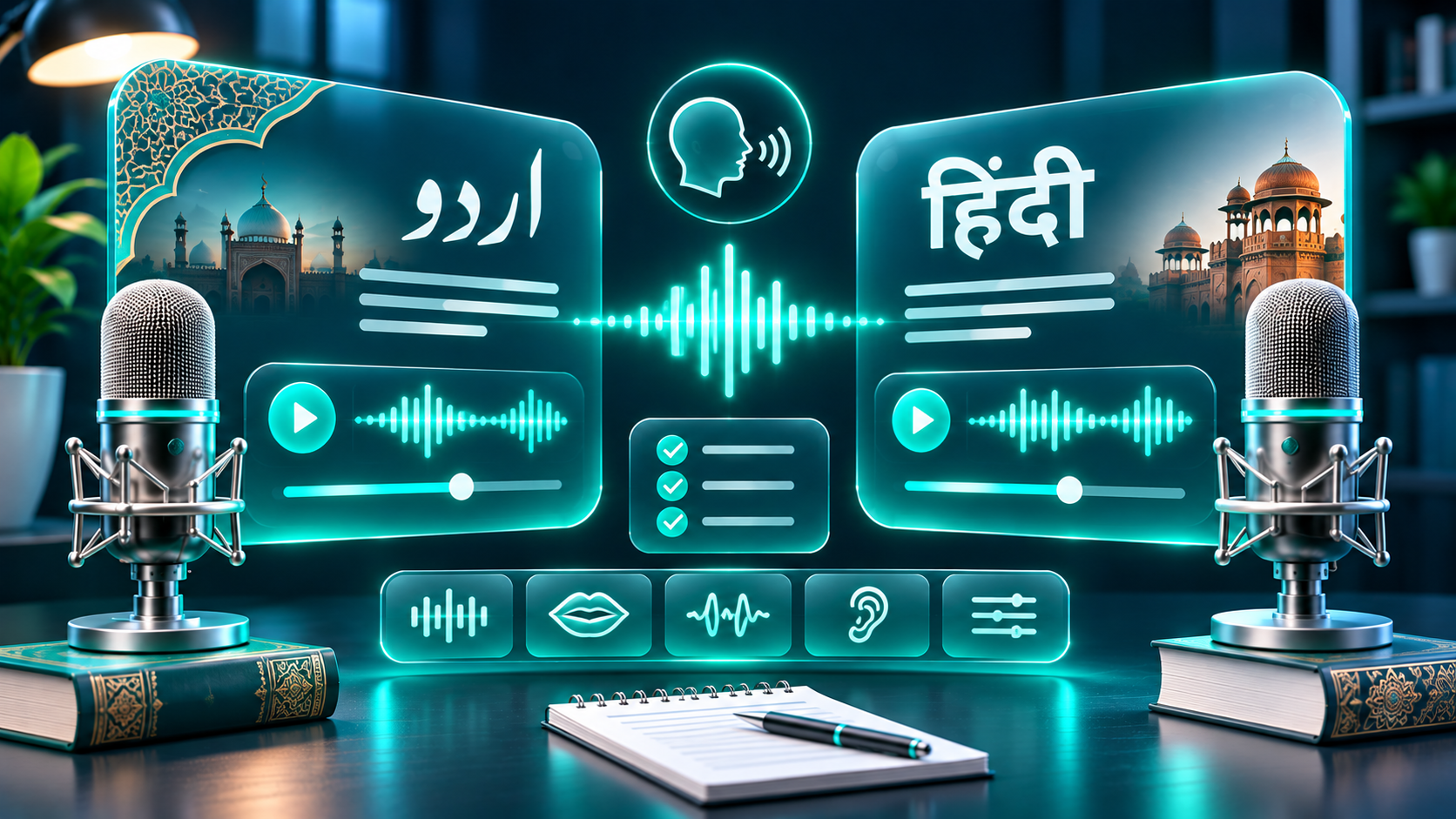
Hindi and Urdu voiceovers often sound closer in everyday conversation than their written forms suggest. The two share a closely related spoken base, while formal vocabulary, script, cultural context, and some pronunciation choices can signal a particular audience or register. The goal is not to manufacture an accent. It is to make the words, delivery, and voice fit the people who will hear them.
Start with the audience, not the label
Hindi and Urdu share much of their grammar and everyday vocabulary, and ordinary speech can be mutually intelligible. Their differences become more noticeable in formal vocabulary and writing: standard Hindi draws more heavily on Sanskrit-derived terms, while formal Urdu uses more Persian- and Arabic-derived vocabulary. Both also contain familiar shared words and regional mixtures.
“Hindi” and “Urdu” do not each describe one uniform spoken accent. Consider listeners’ region, their terms for the subject, and the desired formality. A broad conversational explainer may use a shared Hindustani register; literary or culturally specific work may need more audience-specific vocabulary.
Before production, note the intended region, formality, and key words. Ask a fluent reviewer from the target audience to check phrasing rather than relying on the language label alone.
Script changes what the narrator sees
Standard Hindi is commonly written in Devanagari, read from left to right. Urdu is commonly written in a modified Perso-Arabic script, often in the Nastaliq style, and read from right to left. The same spoken phrase can therefore appear quite different on the page:
Hindi: आप कैसे हैं?
Urdu: آپ کیسے ہیں؟
Romanized: Aap kaise hain? (“How are you?”)
A Roman spelling is a convenience, not a single pronunciation standard. Aap/āp and kaise/kaisay reflect differing transliteration habits. If using Roman script, keep spellings consistent and ask a fluent speaker to review them. Confirm in the current interface that the chosen tool handles your script and language before producing a full project.
Devanagari consonant symbols carry an inherent-vowel convention, so writing is not a simple letter-for-letter sound map. Punctuation, names, and numbers can also affect generated speech. Preview a short passage and review words in context.
Pronunciation: shared foundations, careful distinctions
Avoid coaching Urdu and Hindi as if they require completely separate mouth mechanics. They share a closely related sound system. Both include important contrasts such as dental versus retroflex stops and aspirated versus unaspirated stops. A peer-reviewed description of Hindi, for example, identifies stop series across dental and retroflex places of articulation, as well as aspiration contrasts. These are useful listening targets in either language, but individual speakers and regional accents realize sounds differently.
For a practical check, compare a dental consonant, made near the teeth, with a retroflex one, made farther back. Do not automatically substitute an English “t” or “d.” Listen for aspiration, the puff of breath that distinguishes an aspirated consonant. These contrasts are not a cue to exaggerate every sound.
Urdu’s formal vocabulary may include consonants from Persian and Arabic sources. Britannica notes that Urdu retains some sounds in these borrowed words, including /x/ and /q/, but does not preserve every sound from those source languages. A speaker’s realization can vary: for instance, not every Urdu speaker produces a borrowed consonant identically, and Hindi speakers also vary in how they pronounce loanwords. Do not treat a spelling or a community label as proof of one “correct” sound for every voice.
List pronunciations for names, place names, technical terms, and other key words. Add a phonetic cue or authorized reference recording if useful. For everyday words, prefer the form your listeners actually use; ask a fluent audience member when uncertain instead of copying an accent from one media clip.
Vocabulary and register can change the feel
A common source of unnatural narration is a script that uses vocabulary from the wrong register. A formal Hindi script might choose a Sanskrit-derived equivalent where a casual speaker would use a more widely shared word. Formal Urdu may prefer a Perso-Arabic-derived expression, while everyday speech can mix vocabulary across those traditions. Britannica describes this stylistic distance between literary Hindi and literary Urdu, while noting that colloquial Hindi-Urdu includes many Perso-Arabic words.
For example, kitāb (“book”) is used in everyday Hindi and Urdu, though the writing differs: किताब and کتاب. For “freedom,” āzādī is familiar across Hindi- and Urdu-speaking settings, while the formal Hindi word svatantratā is a different register. These are examples, not rules about what every person will say. A Hindi audience may know āzādī, and an Urdu speaker may understand Sanskrit-derived vocabulary; recognition does not necessarily mean that a word sounds natural in every sentence.
Read the script aloud with a target listener. Replace words that feel translated, overly literary, or too regional. Keep names, dates, and borrowed English terms recognizable, and review language switches in bilingual scripts.
Choose a voice for fit, then test it
“Hindi voice” or “Urdu voice” is not enough to choose a narrator. Define the tone—conversational, reassuring, formal, energetic, or reflective—and consider the audience’s region and familiarity with the topic. Avoid assuming that gender, pitch, or national label guarantees authenticity.
Audition challenging lines: a greeting, name, borrowed word, number, and longer sentence. Listen for consonants, rhythm, and endings; ask a fluent listener whether the voice is clear and appropriate, not whether it matches a stereotype. Check current product options directly; this article does not verify FlashTTS support for a specific Urdu or Hindi voice.
[Screenshot placeholder: Add a current FlashTTS interface screenshot showing the language and voice options available to the author at publication time, if it can be captured accurately.]
A useful check is a short A/B sample in the intended script and a reviewed transliteration, if both are valid inputs. Ask a fluent speaker to flag misread words before producing the full narration.
Rights, disclosure, monetization, and voice cloning
A synthesized voice does not clear rights to your script, translations, music, or other audio. YouTube advises creators to have a valid basis, such as permission or a license, for another person’s copyrighted work; no option guarantees avoiding a claim. Check applicable terms rather than assuming a speech tool grants rights in source material.
YouTube requires disclosure for realistic AI-generated or altered content in specified cases, such as making a real person appear to say something they did not or generating a realistic scene that never happened. Disclosure alone does not limit audience or monetization eligibility. Check current upload guidance for your use case; ordinary narration and realistic imitation are not necessarily treated alike.
Disclosure is not a shortcut to monetization. YouTube’s monetization rules expect original, authentic content and identify repetitive or mass-produced material as ineligible under its inauthentic-content policy. A different voice cannot make copied or low-value material original.
Use a voice clone only with the speaker’s informed permission. YouTube warns against unauthorized AI copying that falsely suggests a person owns or authorizes a channel or message. Do not imitate someone to imply endorsement or mislead listeners.
For synthetic audio, naturalness comes from editorial care as much as pronunciation. To explore a workflow, visit
FlashTTS Text to Speech and check current language and voice choices in the interface; this link does not guarantee a particular Urdu or Hindi option is available.
Frequently asked questions
Are Urdu and Hindi pronounced the same way?
They share a spoken foundation, but vocabulary, register, and regional variation affect individual lines. Neither label means one accent.
Should I write the script in Urdu or Hindi script?
Devanagari is common for Hindi and Nastaliq-style Perso-Arabic script for Urdu. Check script handling and pronunciation with the actual tool and a fluent reviewer.
Can I use Roman Urdu or Roman Hindi for voice generation?
Only if the tool reads it reliably. Romanize consistently, test difficult words, and confirm language support in the current interface.
Does AI narration automatically make a video ineligible for monetization?
Disclosure alone does not affect eligibility, but monetization still depends on rules for originality and repetitive or mass-produced content. Check current policies.
Can I clone a voice for an Urdu or Hindi narration?
Only with speaker permission; do not imply someone said or endorsed something they did not. Verify current language support and use-case terms.